
As Chief Investment Officer at Confluence Financial Partners, Bill Winkeler, CFA, CFP® oversees the firm’s investment philosophy, portfolio construction, market research, and overall investment strategy. Each quarter, he provides perspective on the market environment, key economic developments, and investment trends to help investors better understand what is shaping the financial landscape.
The commentary below is intended for educational and informational purposes and should not be considered personalized investment advice.
Strongest Quarter Since 2020 for Stocks
- S&P 500 posted its strongest quarter since the second quarter of 2020 as geopolitical pressures eased and earnings growth accelerated
- Driven by record AI-related capital expenditures, earnings growth sharply accelerated during the quarter, but also broadened to other areas of the equity market
- Economic growth firmed during the quarter, along with an uptick in job creation, steadying the outlook for the labor market
- Interest rate outlook shifted significantly, with investors no longer expecting rate cuts in 2026, as Kevin Warsh was confirmed as the next chairman of the Federal Reserve
What Happened in the Second Quarter?
Equity markets had one of their stronger quarters in recent memory, with the S&P 500 TR Index returning +15.2%, its best quarter since the second quarter of 2020. The sharp decline in energy prices was a tailwind (Brent crude oil fell -38% during the quarter), along with a continued increase in earnings growth expectations throughout the quarter. IPO activity returned in a big way as well, with SpaceX listing on public exchanges to much fanfare. To learn more about how IPOs work and what investors should consider, read our guide to initial public offerings.
Technology stocks rebounded during the quarter on the back of record investment in artificial intelligence, which helped push large cap growth stocks +16.74% higher in 2Q 2026 (Russell 1000 Growth TR Index). Domestically, value stocks (+13.87%, Russell 1000 Value TR index) and small cap stocks (+21.49%, Russell 2000 TR Index) also had strong quarters. Small cap stocks, particularly profitable small cap companies, continue to trade a sharp discount to large cap stock indices, despite an improving earnings growth outlook.
International equity markets also had a positive quarter despite higher sensitivity to energy prices. Developed international equities rose +10.82% (MSCI EAFE NR USD Index), and emerging markets benefitted from the Technology rally, with the MSCI Emerging Markets Equity NR USD Index rising +24.05% during the quarter.
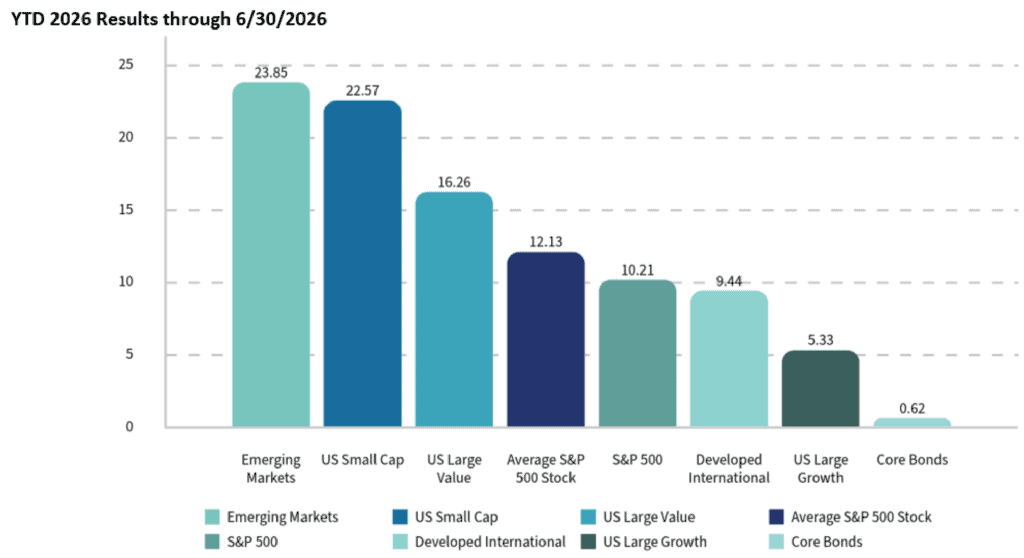
Sources: Morningstar, Average S&P 500 Stock = S&P 500 Equal Weighted TR Index, US Large Caps = S&P 500 TR Index, US Small Cap = Russell 2000 TR Index, Developed International = MSCI EAFE NR Index, Emerging Markets = MSCI Emerging Markets NR Index, Core Bonds = Bloomberg US Agg Bond TR Index, US Large Growth = Russell 1000 Growth TR Index, US Large Value = Russell 1000 Value TR Index
S&P 500 Dividend Yield Near 30 Year Lows
The S&P 500’s dividend yield stands at roughly 1% today, which is near its lowest level in the last 30 years. This has not always been the case- dividends have historically played an important part of an investor’s total return in the stock market: since the 1930s, dividends have represented 59% of an investor’s total return in the S&P 500 Index. However, when diving deeper into the data, there has been a significant shift over the last 20 years- particularly since 2020. Since 2020, dividends have only represented 15.4% of the S&P 500’s total return. What is driving this trend?
For the S&P 500, a significant driver has been the shifting composition of the index. Today, roughly 37% of the index is represented by Technology companies, with another 10% represented by Communication Services companies. With nearly half the index in Technology/Technology-related companies, their preferences have a significant impact on the index. These companies tend to favor share buybacks over dividends and have more recently increased capital expenditures. The net impact is significant: the dividend payout ratio of the S&P 500 is at all-time low (portion of a company’s earnings paid out in dividends).
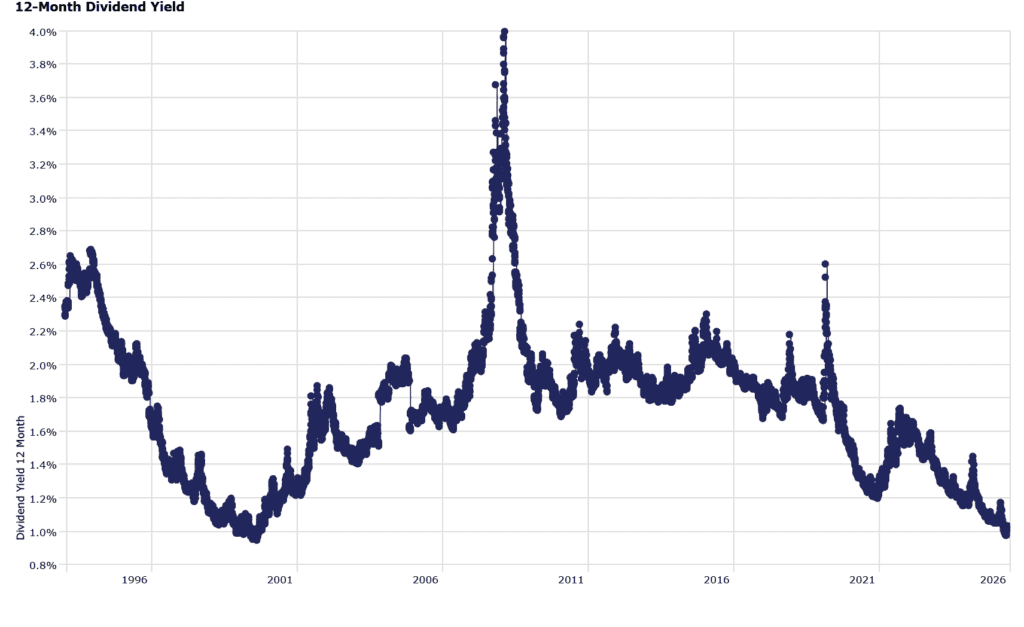
Sources: Morningstar Direct, 12-month dividend yield represented by the State Street SPDR S&P 500 ETF (SPY).
Various valuation metrics for the S&P 500 Index are also elevated for investors; this also includes metrics relative to fixed income investments. Even when combining the benefit of dividend yield and share buybacks, the total shareholder return for the S&P 500 is well below the current yield on 10-year US Treasuries. Illustrated another way, only 8% of the S&P 500 companies have a dividend yield greater than the yield of the 10-Year US Treasury, well below the 30-year average of 20%.
The implication for investors is important – for those with primary or secondary objectives of income, the composition of their equity exposure is an increasingly important consideration. Confluence’s Investment Advisory Committee works closely with our advisors and their clients on considerations such as this – read more about our investment process here.
What’s Ahead for the Third Quarter?
The on-going negotiations in the Middle East will remain top of mind, given the lingering pressures on energy supply globally. This also drives increased focus on inflation data and Federal Reserve policy, which is undergoing changes under new Chairman Kevin Warsh. Futures markets are pricing in an 80% probability of a 0.25% interest rate hike by 9/16/2026 (as of 7/1/2026).
Investment in artificial intelligence, particularly its components, is also top of mind for investors. Pricing pressures are emerging in components such as memory chips, with companies such as Apple having to pass on price increases to end consumers. Apple raised prices of laptops and desktops by 15% to 25% in June, along with other product offerings. Continued broadening of pricing pressures due to AI investment will be closely watched by investors.
About the Author
Bill Winkeler, CFA, CFP® serves as Chief Investment Officer at Confluence Financial Partners, where he leads the firm’s investment philosophy, portfolio construction, market research, and investment strategy. He chairs the firm’s Investment Advisory Committee and has more than 15 years of experience in the investment industry. Bill holds a Bachelor of Science in Finance from the University of Pittsburgh and is both a Chartered Financial Analyst® (CFA®) charterholder and a CERTIFIED FINANCIAL PLANNER® professional. Through his market commentary, he provides educational insights to help investors better understand economic and market developments.
*Past performance is not indicative of future results. The S & P 500 Index is a broad, unmanaged index of 500 of the largest US publicly traded companies and does not reflect the impact of fees, taxes or expenses. Any investment in the S&P 500 or similar indices, like the Russell 1000 and Russell 2000, involves risk, including the potential loss of principal and they do not reflect the costs of investing in an actual portfolio. Investors should consider their individual risk, tolerance, investment objectives, and consult with a financial professional before making investment decisions.