
Month in Review
- Busy month for financial markets: first rate hike since July 2023, persistent inflation (66 consecutive months with core PCE above the Fed’s 2% target) and concerns around the sustainability of the AI capex boom.
- Rising long-term bond yields continued to push equity valuations lower despite stronger earnings, with the S&P 500’s forward P/E ratio standing at roughly 19x, down from 23x a year ago.
- The US dollar benefitted from the rise in interest rates, turning into a headwind during the month for international equity investments. The international equity market index (MSCI ACWI ex USA NR Index) fell 2.4% in US dollar terms during the month, compared to a 1.3% decline in local currency.
- Stubborn inflation drove bond yields higher, which also pushed the Federal Reserve to forecast potentially more rate hikes in the future (following the September hike). These factors pushed the yield on the 10-year Treasury up 54 basis points (to 5.29%) in September, resulting in the Bloomberg US Aggregate Bond Index falling 2.6% for the month.
Narrowing Leadership
Inflation remained well above the Fed’s target as energy costs climbed, with the US average diesel price reaching $6.53 per gallon on September 21st, the highest in the EIA’s 32 years of data. Persistent inflation was a key factor in driving bond yields sharply higher in September. The Federal Reserve responded by increasing the Federal Funds Rate by 0.25%, the first hike since July 2023. The net result was a significant increase in long-term bond yields, which created more volatility than the S&P 500’s 0.35% monthly decline indicates.
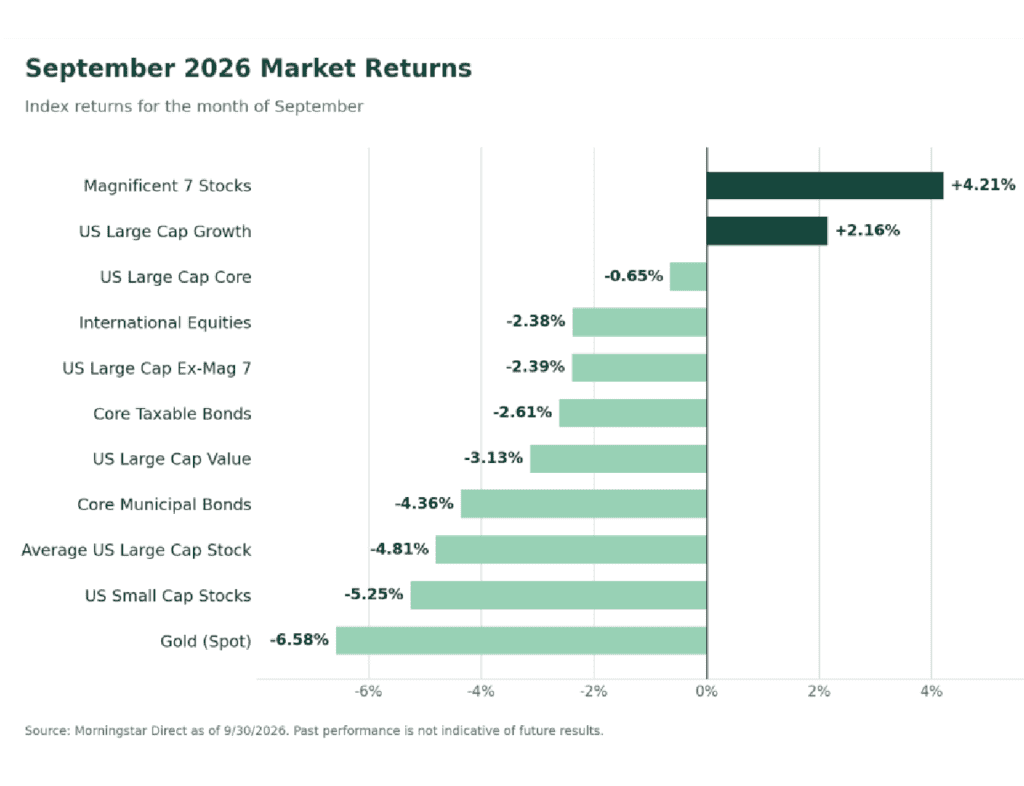
The combined effect of these factors resulted in very narrow market leadership across equity markets and asset classes. Within equity markets, in the US, 10 of the 11 S&P 500 sectors were negative for the month. Magnificent 7 stocks rose 4.2%; excluding those seven companies, the Russell 1000 TR Index would have fallen 2.4% in September (Russell 1000 Ex-Mag 7 TR Index), while the average S&P 500 stock (S&P 500 Equal Weighted TR Index) fell 4.8%. Higher yields weighed on both bonds and gold, which fell 6.6% in September. This highlights the broader impact of the sharp increase in US Treasury yields during September.
What’s on Deck for October?
- Investors will be focused on the direction of inflation, watching inflation-related data closely for signs of easing. The Federal Reserve indicated additional rate hikes during the September meeting, with futures markets (CME FedWatch) pricing a 37% probability of a 0.25% increase at the October 28th meeting (as of 10/1/2026).
- Third-quarter earnings season begins in mid-October. Analysts expect S&P 500 earnings growth of roughly 29% year-over-year for the quarter (FactSet, as of 9/11/2026), which has helped the market offset the decline in valuation multiples.

*Past performance is not indicative of future results. The S & P 500 Index is a broad, unmanaged index of 500 of the largest US publicly traded companies and does not reflect the impact of fees, taxes or expenses. Any investment in the S&P 500 or similar indices, like the Russell 1000 and Russell 2000, involves risk, including the potential loss of principal and they do not reflect the costs of investing in an actual portfolio. Investors should consider their individual risk, tolerance, investment objectives, and consult with a financial professional before making investment decisions.