

Every election cycle brings questions about what political outcomes may mean for the economy, markets, and individual portfolios. Headlines become more frequent, predictions become more confident, and uncertainty often feels unavoidable. Yet when we step back and look at history, one thing becomes clear: markets have proven remarkably resilient through changing political environments.
While every election cycle is unique, decades of market data can provide valuable perspective for investors. Political events can influence short-term sentiment and contribute to market volatility, but they have historically played a much smaller role in long-term investment returns than many investors may assume. There are several historical trends that are worth keeping in mind as we approach another midterm election cycle.
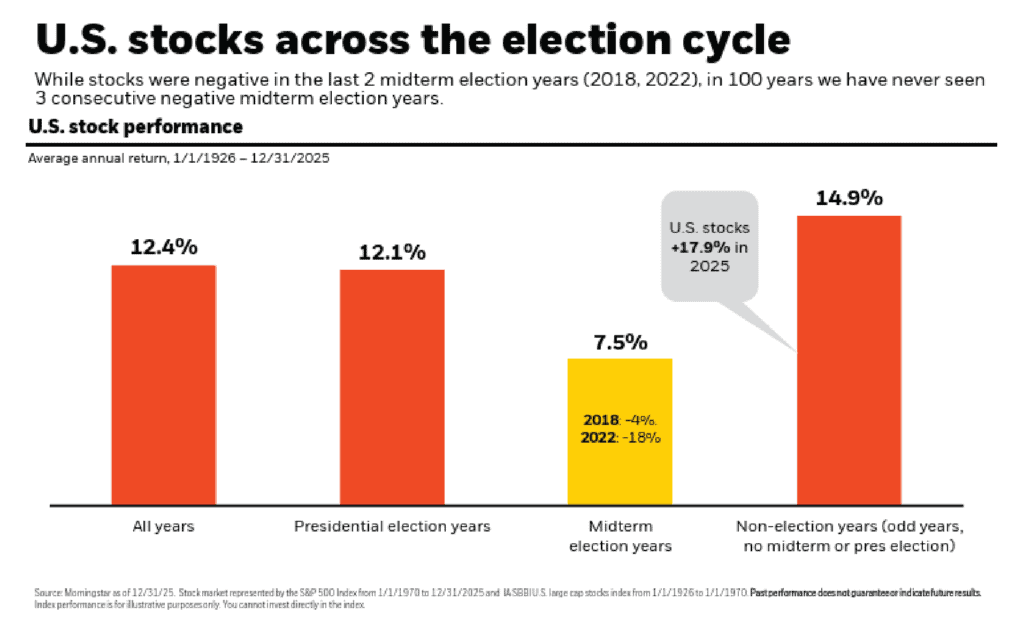
Midterm elections are held near the midpoint of a president’s four-year term and are often viewed as a referendum on the current administration. Historically, the president’s party has lost congressional seats during these elections, a trend that markets have largely come to expect over time. Political shifts may influence legislative priorities in Washington, but investors should remember that election outcomes are only one of many factors that influence market performance. Economic growth, interest rates, inflation, corporate earnings, and global events often have a more meaningful and lasting impact on investment returns. Historically, markets have exhibited several unique characteristics during midterm election years. Returns have tended to be more muted during the early part of the year as investors grapple with uncertainty surrounding election outcomes and potential policy changes. This is not unusual, and markets generally dislike uncertainty of any kind. However, history also shows that markets often begin to recover as Election Day approaches and have frequently continued to perform well in the months that follow. Since 1931, midterm election years have produced a positive average return for the S&P 500 Index, averaging 4.7%, reinforcing the importance of maintaining a long-term perspective even when short-term uncertainty dominates the news cycle. [1]
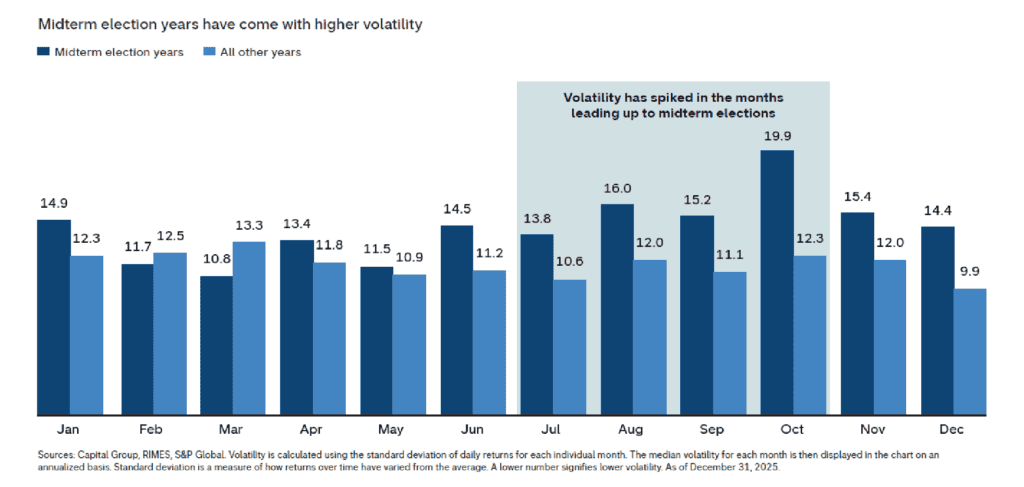
Periods of political uncertainty also tend to bring increased market volatility. Campaigns naturally focus on competing visions for the country’s future, proposed policy changes, and economic priorities, all of which can contribute to investor anxiety. Midterm election years have historically experienced higher levels of market volatility than non-election years, particularly in the months leading up to Election Day. [2] While market swings can be uncomfortable, volatility is a normal part of investing and should not immediately be viewed as a reason to alter a thoughtfully constructed and executed investment strategy. Historically, investors who maintained a disciplined, long-term investment approach during periods of uncertainty have often experienced favorable outcomes, although future results may differ.
In fact, one of the more encouraging historical trends surrounding midterm elections is what typically occurs after the votes have been counted. Markets have frequently delivered strong returns in the year following midterm elections as political uncertainty begins to fade and investors refocus on broader economic and corporate fundamental concepts. [3] While past performance is never a guarantee of future results, historical data demonstrates that periods of uncertainty can often be followed by periods of meaningful opportunity. Investors who remain committed to their long-term plans have historically been rewarded for their patience.
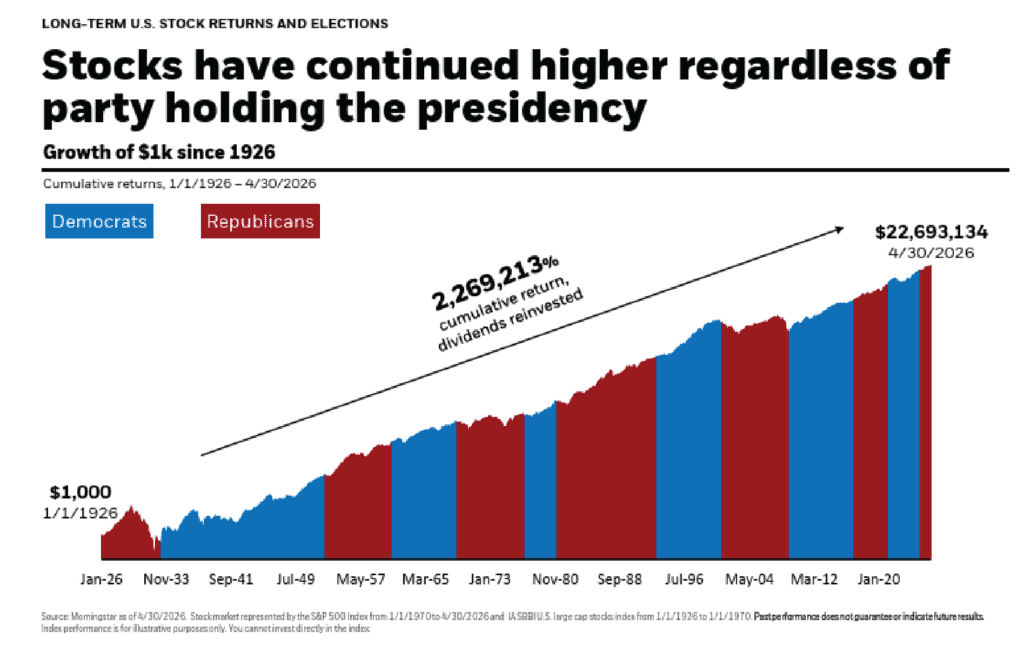
Perhaps most importantly, market history suggests that long-term investment success has been largely independent of which political party controls Washington. Whether government has been unified or divided, equity markets have historically generated attractive long-term returns. Companies continue to innovate, consumers continue to spend, and businesses continue to adapt regardless of election outcomes. For many investors, maintaining an investment strategy consistent with their objectives, risk tolerance, and financial circumstances may be more beneficial than making decisions based solely on election-related uncertainty.
At Confluence Financial Partners, we believe that thoughtful financial planning and disciplined investing are designed to withstand changing market and political environments. Midterm elections may influence the conversation in the months ahead, but history reminds us that staying invested and maintaining perspective remain among the most important decisions an investor can make.

Confluence Financial PartnersThis commentary is provided for informational purposes only and should not be construed as personalized investment advice or a recommendation to buy or sell any security. The views expressed are those of the author as of the date of publication and are subject to change. Past performance is not indicative of future results. Historical market trends discussed herein are for illustrative purposes only and may not be repeated in future periods. Investing involves risk, including the possible loss of principal. The S&P 500 Index is an unmanaged index and cannot be invested in directly. Investors should consult with their financial adviser before making investment decisions. Confluence Wealth Services, LLC. d/b/a Confluence Financial Partners is an SEC-registered investment adviser. Registration of an investment adviser does not imply any level of skill or training. Please refer to our Form ADV Part 2A and Form CRS for further information regarding our investment services and their corresponding risks. Additional information about Confluence Wealth Services, LLC. is available on the Investment Adviser Public Disclosure (IAPD) website at: www.adviserinfo.sec.gov.
[1] Source: Capital Group, “How U.S. midterm elections affect the markets,” January 2026. S&P 500 Index data, 1970–2025. Volatility measured by standard deviation of daily returns. Past performance is not indicative of future results.
[2] Capital Group, How U.S. Midterm Elections May Affect Markets, 2026; sources: Capital Group, RIMES and S&P Global.
[3] Source: LPL Research, “What History Shows in Midterm Election Years,” July 2026; Bloomberg. The S&P 500 has risen in the 12 months following midterm elections 18 consecutive times since 1954, with an average gain of 18.2%. Past performance is not indicative of future results.