

If you’ve ever reviewed the investment options in your 401(k), you’ve likely come across funds with names that include a year, such as 2035, 2040, or 2045. These are called Target Date Funds, and they’re designed to simplify retirement investing.
The concept is straightforward. You select a fund based on the year you expect to retire, and the fund automatically adjusts your mix of stocks and bonds as that date approaches. Generally, the closer you get to retirement, the more conservative the investment allocation becomes.
For many investors, this hands-off approach can be convenient. But as your wealth grows and your financial situation becomes more complex, your anticipated retirement date alone may not be enough to determine the investment strategy that best aligns with your goals.
Two Paths, One 2035 Fund
Target Date Funds generally follow a predetermined investment strategy based on your expected retirement date. But retirement planning involves much more than simply knowing when you want to stop working.
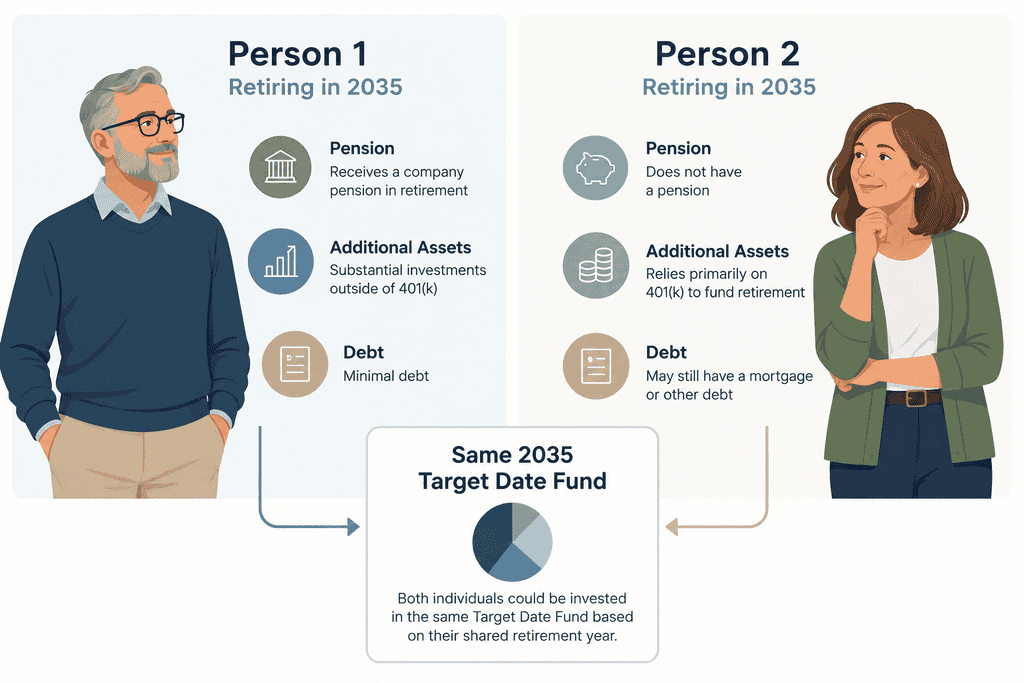
Consider two individuals planning to retire in 2035. One has a pension, substantial investments outside their 401(k), and minimal debt. The other expects to rely primarily on their 401(k) to fund retirement.
Despite their different financial circumstances, both could be invested in the same Target Date Fund.
That’s where a one-size-fits-all approach may fall short.
The Advantages of Target Date Funds
Target Date Funds offer several benefits that make them a popular option within employer-sponsored retirement plans.
- Simplicity: Investors can select a single fund based on their anticipated retirement year rather than managing multiple investments.
- Automatic Adjustments: The fund gradually adjusts its allocation as retirement approaches, reducing the need for ongoing investment decisions.
- Diversification: Most Target Date Funds invest across multiple asset classes, helping spread investment risk.
- Convenience: A hands-off approach can be appealing for investors who prefer not to actively manage their retirement investments.
The Potential Disadvantages of Target Date Funds
While these funds offer convenience, they also have limitations worth considering, particularly as your financial situation evolves.
- One-Size-Fits-All Approach: Two individuals retiring in the same year may have very different financial circumstances, yet could be invested in the same fund.
- Limited Personalization: Target Date Funds typically don’t account for your other investments, pension income, tax situation, or individual retirement goals.
- Different Risk Levels: Funds with the same target retirement year can have different investment allocations and levels of risk depending on the provider.
- Investment Costs: Fees vary among funds and can impact long-term investment returns.
Is It Time for a Second Look?
Target Date Funds can be an appropriate solution for many investors. The question isn’t whether these funds are inherently good or bad, but whether they’re the right fit for your individual circumstances.
As you approach retirement, your financial priorities may shift. Taking time to review your investment allocation can help ensure your retirement savings remain aligned with the goals you’re working toward.
Let’s Review Your Retirement Strategy
At Confluence Financial Partners, we believe your investments should work together as part of a coordinated financial plan.
If you’re unsure whether your current 401(k) investments align with your long-term goals, our team would be happy to review your approach and help you explore your options.

This material is provided for educational purposes only and should not be construed as individualized investment advice or a recommendation regarding any particular investment or strategy. Investing involves risk, including possible loss of principal.